Custom Search
Custom Search
Showing posts with label Pigeons. Show all posts

Friday, May 28, 2010

Training Carrier Pigeons

Carrier pigeons return home after long flights. Time for training pigeon is usually kept less because carrier pigeon take less time to train. Carrier pigeons were used as a communication method in World War i and ii for messaging purpose were the message was taped to their leg and was sent to the required destination. Some people even train carrier pigeons for racing. No matter what your purpose is but with repetition and patience you can train a carrier pigeon in a short period of time.

Instructions
  1. In order to train a carrier pigeon we should start the training with young birds that have not flown yet. Place them into a closed area everyday which is called a fly pen. Place food and water in the loft so they can associate going into the loft with being fed. Do this only for two weeks.
  2. Open the fly pen and let the pigeons out. Don’t get frightened if they fly around. Some may also go for the ground. After few days they will get used up and start to return to the loft to eat.
  3. Begin training when the pigeons leave for an hour before returning to their loft. Then take the pigeons out for five to 10 miles.
  4. Practice by letting the birds to return. When they have done correctly three times then double the distance and repeat. Work until you reach up to 50 miles.
  5. Continue training the process once a week, even after the birds are regularly returning home. In the winter try to avoid practice during cloudy season. Try to change the directions when releasing them. This is done in order to get them used up from all directions i.e. north, south, east and west. Start at five miles from the loft, then go on increasing distance each time you change direction.
  6. Release the young birds every time when you feed them because young pigeons need lot of food during training.
Tips & Warnings

It is better to release the pigeons in the morning then in afternoon to train them. Fly them only on clear and sunny days when there is little or no wind. If there are losses slow down the training. Do not over train the carrier pigeons. Most pigeons find their way home from 50 miles but in exceptional cases from 200 miles. Starting days will be hardest so be patient. Never ever scare the pigeons when they are in loft. They feel safe and always wanted to stay with each other.

Tuesday, March 30, 2010

Strasser Pigeon

Strasser Pigeon
Strasser Pigeon
[More Pictures]

Hungarian ............. Strasser galamb
Macedonian ........... Штрасер Pigeon
Persian ................. Strasser کبوتر

Strasser Pigeon originated in Austria as a utility pegion, is very popular as fancy pigeon. It has a colored head, neck, wings, and tail with colored feathers on the back. The rest of the body is white. The colors include, black lace, lark colors, blue, blue barred, black or white barred, blue checkered, red or yellow. Strasser pigeons resemble with King pigeon and Modena, but have a shorter height than both of them. These birds looks like a small hen, very cute and innocent. They have black eyes with a red colored ring covering it. The finest pigeon breed, which I like the most.

Thursday, January 28, 2010

South German Charcoal Lark Pigeon

South German Charcoal Lark Pigeon

South German Charcoal Lark Pigeon
French ................ Charbon de bois Lark Pigeon
Galician ............... Carbón Lark Pigeon
Greek .................. Άνθρακες Lark Pigeon
Haitian ................. Creole Chabon alwèt Pigeon

Origin .................. Germany
Family .................. Lark
Type .................... Utility Pigeons
Similar Breeds ........ Nuremberg Lark Pigeon, Coburg Lark Pigeon
Colour ..................Standard Pattern (Chequered)
Resemblance ......... Dove

The head and neck is completely black in color having a green and purple shade. The breasts are brownish in color. Wings are chequered and are a combination of grey and black color, beautifully arranged in an evenly order. The long feathers of wings are black in color. Eyes are black and have red ring around it. The Tail is dark grey in color, almost black. The lower body is also dark grey in color with a purple shade in it. The legs are plain and have a long dark beak. The finest bird among all the pigeon breeds having silky effect. These birds are excellent parents, an active breed, will become tame but do not like to be being handled.

Monday, January 04, 2010

Coburg Lark Pigeon

Coburg Lark Pigeon
Coburg Lark Pigeon
Albanian ............ Koburg Lark Pigeon
Bulgarian ........... Кобург чучулига Гълъб
Estonian ............ Coburg Lark Tuvi
Filipino ............. Coburg magkatuwaan Pigeon

Origin .............. Germany
Family .............. Lark
Type ................ Utility Pigeons
Color ............... Standard Pattern (Plain and chequered)
Resemblance ...... Dove

This pigeon, also called Koburger lark or gold leads lark. The head is completely light grey in color. The neck is dark grey in color or some times a shade of green color is seen. The breasts are brownish yellow in color. Wings are chequered or plain light grey in color. Chequered wings are a combination of grey and black color, beautifully arranged in an evenly order. Plain wings have diluted grey color. The long feathers of wings are black in color. Eyes are black and have red cere around it. The Tail is dark grey in color, almost black. The lower body is also diluted grey in color. The legs are plain and have a long beak. The finest bird among all the pigeon breeds having silky effect. These birds These birds are excellent parents, an active breed, will become tame but do not like to be being handled.

Tuesday, December 01, 2009

Egyptian Swift Pigeon

In Egypt we have many pigeon breeds from different kinds, fliers group, owls group, homers group and tumblers group. The most famous one is the flier group which called the Egyptian swift, these group divided into some breeds. The Egyptian pigeon is a distinct breed of pigeons native to the country of the pyramids. Egyptian pigeons are better known as "the Egyptian Swift". The breed was first recognized as a distinct version of the conventional pigeon back in the 18th century.
Its narrow body characterizes the Egyptian pigeon, which is long and sloping with a concave back. These birds have a relatively low station and stand upright upon short legs. Compared to its body the Egyptian pigeon has a relatively smaller and articulate head fitted with a small beak. On observation you will find that the legs of the pegion do not have any feathers under the hock. It is because of these characteristics that the Egyptian pigeon was assigned the name of "Swift". The body of the Egyptian Swift is covered with a dense lining of long feathers that are very brittle in nature. The characteristics mentioned here are the standards for the show bird version of the Egyptian pigeon.

Sunday, August 02, 2009

Syrian Fantail Pigeon Pictures

Syrian FantailSyrian fantail pigeons are found less in the world. So it is recommended for the pigeon breeders that are breeding pigeons should not loose this breed. We should work hard to increase this bird because their white tail makes them differ from other fantail pigeon.Syrian Fantail
Syrian Fantail Pigeons
Black Fantail
Syrian Fantail Pigeon
Black Fantails
[Previous] [Next]

Wednesday, June 10, 2009

Indian Fantail Pigeons Pictures

White Fantail
The Indian fantail doves are also known as homing doves. People usually keep these pigeons because they make the beauty of their home. They do give eggs in similar pattern as other pigeons do. Usually gives birth to 2 or 3 baby doves at a time. These baby doves takes at-least 4 to 6 weeks to fly and leave their home.


White fantails
Black Fantail Pigeon
white doves
white fantail doves
white fantail pigeon
Brown Indian Fantail
white fantail pigeons
Black Fantail Pigeon
Black Fantails
white pigeons doves
Grey Indian Fantail Pigeon
Grey Fantail Pigeon
white garden doves
white doves

Saturday, May 30, 2009

Budapest Tumbler Pigeon

Budapest HighflierPoltli - Fancy Pigeons - Homing Pigeons

The Budapest Tumbler Pigeon is a fairly recent breed developed in the late 19th century to the beginning of the 20th century. They were originally bred for highflying, but now they are primarily bred for showroom competition. They are lively little birds and usually only weigh about four to six ounces. The most prominent feature of this pegion breed is its head. It is wide and short with the width and length being of the same dimensions, forming a "V" down to the wattle. The back of the head is sharply marked upward, forming three corners. The beak, while being short and thick, is straight set. The large eyes are pearl in color, with thick ceres almost frog like. Black ceres are called for in the black beak variety, and flesh colored in the white beak variety. The neck is long and slightly arched, with the wing butts carried slightly outwards.

Saturday, May 09, 2009

Voorburg Shield Cropper Pigeon

A member of the Pouter Family of pigeons, the Voorburg Cropper was a creation of the famous geneticist and illustrator, the late Mr. C. S. van Gink, who at his twenties, was obsessed by his intense desire to someday breed White Croppers with colored breast. It was not until 1929 that his dream came true and the actual breed originated. This breed owes its name to the fact that its cradle stood in one of the finest gardens in the town of Voorburg, near the Hague.
To acquire the beautiful markings and color, van Gink also started crossbreeding with the Schild pigeons. This type of pigeon when mated to a clean-legged pigeon will result again in a beautiful clean-legged young. The Voorburg Cropper is a plump, elegant, middle sized bird. Basically the quality of this bird is gauged through the following points: (a) type and posture; (b) pouter capacity; (c) color and markings which are very important.

Friday, May 08, 2009

Old Dutch Capuchine Pigeon


The Capuchine pigeon is one of the older pigeon breeds and likely dates back to the Middle East, Greece or India for its origins. Dutch sailors probably brought Capuchines back to Holland no later than the 1500's by Dutch sailors. We know of its presence in Holland in the 1500's by its depiction in several of the Dutch Masters works of art. Imported into the United States in the 1960s, the Old Dutch Capuchine has enjoyed relative popularity as a rare breed.
Appearance is graceful, medium small size pigeon, medium high, with a horizontally carried body. Short, broad between shoulders, gradually tapering off towards the tail. The horizontal carriage is highly desired. A vertical line is dropped from the center of the eye, should locate about 30 mm in front of the leg. The head is of medium length, very well rounded. It is not "pinch faced" and broad enough at the back to be a sound base for a broad hood.

Monday, May 04, 2009

Shirazi Pigeon


Shakhsharli, are they the most beautiful and unique breed of pigeons? In my opinion it is by far the most stunning breed there is today. There are many different unique names for the Shakhsharli pigeons around the world for example in Iran it is called Shirazi pigeon because of a town called Shiraz, in Turkey it's called Saksarli, and lastly in Lebanon it is known as Shaik. The meaning of the Shakhsharli pigeons is "overdressed with beauty." This breed comes in four original colors black, blue, yellow, and red. This breed has many different features, than other breeds for example the three patches of color on its head. One patch on the top of the head, which is called a “skull patch”, and the last two at each cheek, called "cheek patches." A Shakhsharli heads are averagely large, and round. Their eyes should be black or a dark brown, but sometimes you will receive a pearl, or red eye which is do to mixing breeds. The main importance when receiving a shakhsharli pigeon is its marking. This breed should have a white head and neck to the breast line forming a V shape. It also should be white to a line at the shoulder.

Saturday, May 02, 2009

Fantail Pigeon

The Fantail is a popular breed of fancy pigeon. It was originally called ‘Broad Tailed Shakers’. A fan-shaped tail composed of 30 to 40 feathers; abnormally more than most members of the pigeon family, which usually have 12 to 14 feathers, characterizes it. Their average weight is 13 ounces (369 g) and their average length is 11 inches (28 cm). The breed is thought to have originated in India, China or Spain.
Fantails are often used by pigeon flyers in the training of Racing Pigeons and Tipplers. They are used as droppers in that they are placed on the loft landing board as a signal to the flying birds to come in and be fed. The Fantail is primarily a bird of TYPE and ACTION. ‘TYPE’ meaning to represent typical structural characteristics and posture while standing. ‘ACTION’ meaning behavior and method of performing while in motion.
Fantails are to be judged by comparison to each other, seeking the best refined balance of the strongest traits that define the breed – round body, large tail, well set legs and head while standing and in motion. Round like a ball when viewed from any angle, showing a graceful curve from beak to feet when viewed in profile. Should give the appearance of being slightly hollow in the center. Length of back should be in proportion with length of neck, to allow for proper head setting. Clear, bright, alert, eye ceria as fine as possible and colored in accordance to feather color. Eyes dark for all white-headed colors. Pearl eyes or yellow to orange-red eyes for all other colors.
This pigeon breeds has been described as a "Bundle Of Energy," always moving and showing its tiny delicate head tucked snugly in the vertex of it's rounded chest and large flat tail. There should be a constant back and forth movement of the neck, and the bird should stand on tiptoe and walk elegantly. They are bred in more than fifty colors and marking patterns including self’s; saddles that are all white birds with colored wing shields, and tail marks, which are all white birds with colored tails. Fantails are both docile and friendly. They are easy to raise and make a wonderful addition to any loft.
This most unusual breed of pigeon has been in existence for hundreds of years. Over the years the form has been changed and the tail has become larger. These pigeons are kept as an ornamental feature (Garden Fantail Pigeons) or for exhibiting; they become very tame and breed quite readily.

There are several sub varieties of Fantail Pigeons, such as:-
English Fantail Pigeons / American Fantail Pigeons / Exhibition Fantail Pigeons / Garden Fantail Pigeons


The Broad Tail Shaker is simply referred to today as an English Fantail Pigeons (American Fantail Pigeons, Exhibition Fantail Pigeons, Garden Fantail Pigeons). It is smaller than the Indian Fantail and stands and walks quite differently, still exhibiting some of that shaker shaking. The head is held all the way back against the tail and the tail is held almost vertically. White is the most popular color among them.

Indian Fantail Pigeon / Hindi Fantail Pigeon / Karakand Fantail Pigeon

The Indian Fantail Pigeon, Hindi Fantail Pigeon or Karakand Fantail Pigeon is quite a bit larger, weighing in at 14 to 18 ounces, making it a sturdier looking bird. It stands more horizontal and the tail is more funnel than fan shaped. The feet have short feathers (grouse muffed) and the head shows a slight peak of feathers on the back of the head, referred to as a peak crest.
The Indian Fantail Pigeon can be seen in many colors, including the genetic factors and modifiers that provide basic color variations. In solid self’s, white, black, red, and almond are common, while dun and yellow are less often seen. In pattern self’s, T- pattern, check and bar are all prevalent in ash red and blue and occasionally brown; bar less is present, but rare. The present recognized markings are saddle, body mark, tail mark, and ribbon tail. Currently, new colors and markings are being developed such as monk mark, baldhead and white side.

Syrian Fantails
The Syrian type is distinctive in that it resembles a homing pigeons with a funnel tail.

Thai Fantail
The Thailand type very closely resembles an Indian Fantail Pigeon. The tail is really more of an upside down V shape than a fan shape. It holds its tail sort of in between the Syrian and Indian Fantail.

Silky Fantail Pigeon / Lace Fantail Pigeon

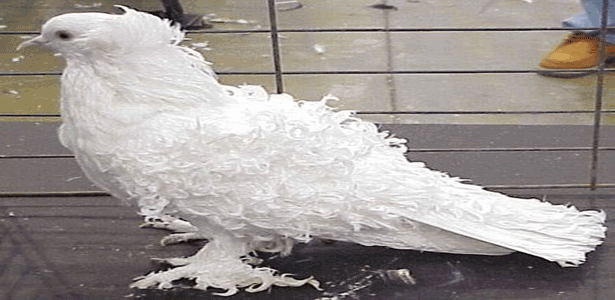
There is a feather mutation called Silky that gives an interesting lace effect to a Fantails tail feathers. Fantails with this mutation are known as Silky Fantail Pigeon or Lace Fantail Pigeon. Silky Fantail is similar to American Fantail Pigeons / English Fantail Pigeons / Exhibition Fantail Pigeons / Garden Fantail Pigeons. The only difference between both of them is the Silky effect on feathers.
Some fantails have a bad habit of walking about with their tails almost horizontal over the body and head, the head and breast nearly touching the ground. These birds should be disregarded, as it is a fault that is often hereditary. The fault previously mentioned of some birds pushing their heads back, and through the center of their tail, can sometimes be remedied, and the habit cured, by tying the three or four center feathers in the tail for a time, so that the bird cannot push its head through them and so cause the break or open space in the tail. When the birds are mated in the springtime, it is advisable to cut off a little more than half of each tail feather, thus securing better results in the fertility of the eggs.