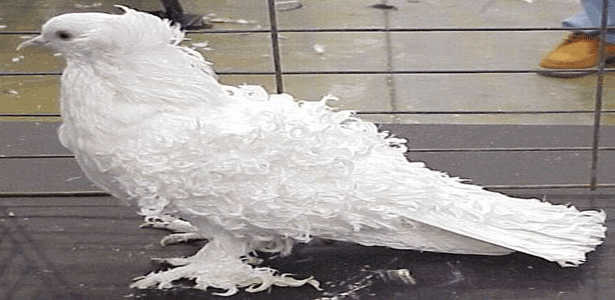
The Fantail is a popular breed of fancy pigeon. It was originally called ‘Broad Tailed Shakers’. A fan-shaped tail composed of 30 to 40 feathers; abnormally more than most members of the pigeon family, which usually have 12 to 14 feathers, characterizes it. Their average weight is 13 ounces (369 g) and their average length is 11 inches (28 cm). The breed is thought to have originated in India, China or Spain.
Fantails are often used by pigeon flyers in the training of Racing Pigeons and Tipplers. They are used as droppers in that they are placed on the loft landing board as a signal to the flying birds to come in and be fed. The Fantail is primarily a bird of TYPE and ACTION. ‘TYPE’ meaning to represent typical structural characteristics and posture while standing. ‘ACTION’ meaning behavior and method of performing while in motion.
Fantails are to be judged by comparison to each other, seeking the best refined balance of the strongest traits that define the breed – round body, large tail, well set legs and head while standing and in motion. Round like a ball when viewed from any angle, showing a graceful curve from beak to feet when viewed in profile. Should give the appearance of being slightly hollow in the center. Length of back should be in proportion with length of neck, to allow for proper head setting. Clear, bright, alert, eye ceria as fine as possible and colored in accordance to feather color. Eyes dark for all white-headed colors. Pearl eyes or yellow to orange-red eyes for all other colors.
This pigeon breeds has been described as a "Bundle Of Energy," always moving and showing its tiny delicate head tucked snugly in the vertex of it's rounded chest and large flat tail. There should be a constant back and forth movement of the neck, and the bird should stand on tiptoe and walk elegantly. They are bred in more than fifty colors and marking patterns including self’s; saddles that are all white birds with colored wing shields, and tail marks, which are all white birds with colored tails. Fantails are both docile and friendly. They are easy to raise and make a wonderful addition to any loft.
This most unusual breed of pigeon has been in existence for hundreds of years. Over the years the form has been changed and the tail has become larger. These pigeons are kept as an ornamental feature (Garden Fantail Pigeons) or for exhibiting; they become very tame and breed quite readily.
There are several sub varieties of Fantail Pigeons, such as:-
English Fantail Pigeons / American Fantail Pigeons / Exhibition Fantail Pigeons / Garden Fantail Pigeons
The Broad Tail Shaker is simply referred to today as an English Fantail Pigeons (American Fantail Pigeons, Exhibition Fantail Pigeons, Garden Fantail Pigeons). It is smaller than the Indian Fantail and stands and walks quite differently, still exhibiting some of that shaker shaking. The head is held all the way back against the tail and the tail is held almost vertically. White is the most popular color among them.
Indian Fantail Pigeon / Hindi Fantail Pigeon / Karakand Fantail Pigeon


The Indian Fantail Pigeon, Hindi Fantail Pigeon or Karakand Fantail Pigeon is quite a bit larger, weighing in at 14 to 18 ounces, making it a sturdier looking bird. It stands more horizontal and the tail is more funnel than fan shaped. The feet have short feathers (grouse muffed) and the head shows a slight peak of feathers on the back of the head, referred to as a peak crest.
The Indian Fantail Pigeon can be seen in many colors, including the genetic factors and modifiers that provide basic color variations. In solid self’s, white, black, red, and almond are common, while dun and yellow are less often seen. In pattern self’s, T- pattern, check and bar are all prevalent in ash red and blue and occasionally brown; bar less is present, but rare. The present recognized markings are saddle, body mark, tail mark, and ribbon tail. Currently, new colors and markings are being developed such as monk mark, baldhead and white side.
The Syrian type is distinctive in that it resembles a homing pigeons with a funnel tail.